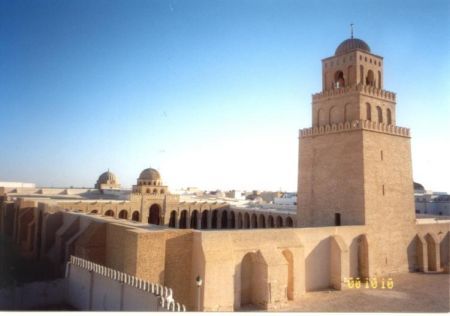
The medina is by far the most popular part of the city for tourists, and with good reason. The Arabic old town, featuring sinuous alleyways with blank walls, beautiful vaulted alleys and famous monumental doors hiding palaces, is the historical core of Tunis. It is a true architectural wonder and became a UNESCO Humanity World Heritage site in 1979. Restoration is constantly in progress on many buildings in order to preserve the rich cultural heritage of the city. The medina mainly encompasses animated Souks selling spice blends, incense, perfume extract, and tanned leather, where the finest handicrafts share space with "Made in China" baubles. Throughout the passing of the centuries, the Souks remained as dynamic as ever, as can be seen for example in the Souk El Attarine , the Souk El Berka , the Souk El Koumach (Souk des Etoffes) , the Souk El Trouk or the Souk Ech-Chaouachiya . In this bewitching universe weighed down by small shops, the merchants and the customers haggle hard for Tunisian green and yellow pottery or a new pair of shoes.
Arabic in culture and tradition, Tunisia is one of the most liberal and tolerant Muslim countries. Although the nomadic Bedouin still follow their traditional way of life in the southern desert, the country's diverse origins can be seen in its architecture, crafts, music and regional folk dances. Tunisia has also developed an international reputation as an intellectual and cultural centre.
With a population of around 1. 5 million people, the capital city of Tunis is a mixture of different things. Its authentic medina (a World-Heritage site) is a large display of Islamic architecture, some dating back more than 1, 000 years. There is also a strong presence of French colonialism, including architecture (and some churches), food and other goods, and the near bi-lingual status of most citizens of Tunis. In contrast to most capitals of Islamic countries, Tunis is surprisingly modern and liberal. Tunis is of mixed identity- not quite Arab, nor African, and not European. Tour through the medina with its many mosques and traditional souks, and you will feel the Arab presence. When you visit the spectacular Bardo Museum or nearby Carthage, you will get a sense of the Roman (and prior to that, the Punic) presence that still strongly influences architecture in the country. Just up the road from Carthage is Sidi Bou Saïd, a whitewashed town with brilliant blue doors and bougainvillea that could easily be mistaken for a small Greek town by the sea.
Tunis is great for shoppers. Popular souvenirs include traditional ceramic bowls, babouches (leather slippers) and djellabas (ankle length robes). Tunisian dates are justifiably famous, while jasmine perfume is a true scent of the country.
Tunis (تونس, Tūnis) is the capital of both the Tunisian Republic and the Tunis Governorate. It is Tunisia's largest city, with a population of 728, 453 as of 2004; the greater metropolitan area holds some 2, 412, 500 inhabitants.
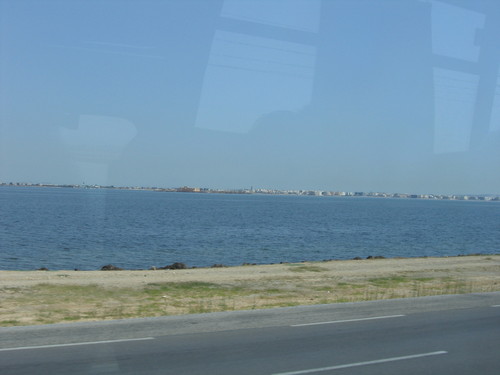
Situated on a large Mediterranean Sea gulf (the Gulf of Tunis), behind the Lake of Tunis and the port of La Goulette (Halq al Wadi), the city extends along the coastal plain and the hills that surround it. At the centre of more modern development (from the colonial era and later) lies the old medina. Beyond this district lie the suburbs of Carthage, La Marsa, and Sidi Bou Said.
The medina is found at the centre of the city: a dense agglomeration of alleys and covered passages, full of intense scents and colours, boisterous and active trade, and a surfeit of goods on offer ranging from leather to plastic, tin to the finest filigree, tourist souvenirs to the works of tiny crafts shops.
Just through the Sea Gate (also known as the Bab el Bahr and the Porte de France) begins the modern city, or Ville Nouvelle, transversed by the grand Avenue Habib Bourguiba (often referred to by popular press and travel guides as "the Tunisian Champs-Élysées"), where the colonial-era buildings provide a clear contrast to smaller, older structures. As the capital city of the country, Tunis is the focus of Tunisian political and administrative life; it is also the centre of the country's commercial activity. The expansion of the Tunisian economy in recent decades is reflected in the booming development of the outer city where one can see clearly the social challenges brought about by rapid modernization in Tunisia.
Description above from the Wikipedia, licensed under CC-BY-SA full list of contributors
here.